Sponsored by: Gold has made another significant move and is once again attracting investor attention after a relatively quiet June and July. While the price was recently hovering around $4,050 per ounce, it rose above $4,400 in early August. Then, on Wednesday, another sharp rise came and the price of gold briefly approached $4,440 per ounce.
Several factors are contributing to the growth. One of the most prominent is the geopolitical situation, which remains tense, especially due to the conflict between the United States and Iran and developments in the Strait of Hormuz. This is crucial for the global transport of energy raw materials. As the risk of further escalation increases, investors often look for assets that can serve as a form of protection against uncertainty. Gold is one of the traditional safe havens.
But the US economy and expectations of further interest rate developments also come into play. If markets are expecting them to fall, gold can benefit from this. Lower rates generally reduce the attractiveness of interest-bearing assets, thereby improving the relative position of precious metals.
Bonds can decide further developments
Investors are therefore paying close attention to US government bonds. The yield on 10-year Treasuries has been minima around 3,94% rose to 4,7%. An even more significant movement was seen in the 30-year bonds, whose yield exceeded 5,3%. The last time it was this high was in 2007.
High yields are a problem for gold. Gold itself does not offer any regular returns. So if an investor can invest their money in bonds with an attractive yield, for example, holding gold means a higher opportunity cost for them.
However, on Wednesday, a change came that significantly affected the situation. The American miniThe Ministry of Finance announced that miniThe Fed will roughly double the volume of long-term bond buybacks. The 30-year bond yield subsequently fell 9 basis points to 5,19%. At the same time, the dollar weakened and gold quickly shot up from around $4,365 to $4,440 per ounce.
It was the combination of a weaker dollar and lower yields that created a favorable environment for gold.
Chart: Gold price development (GOLD, H1)
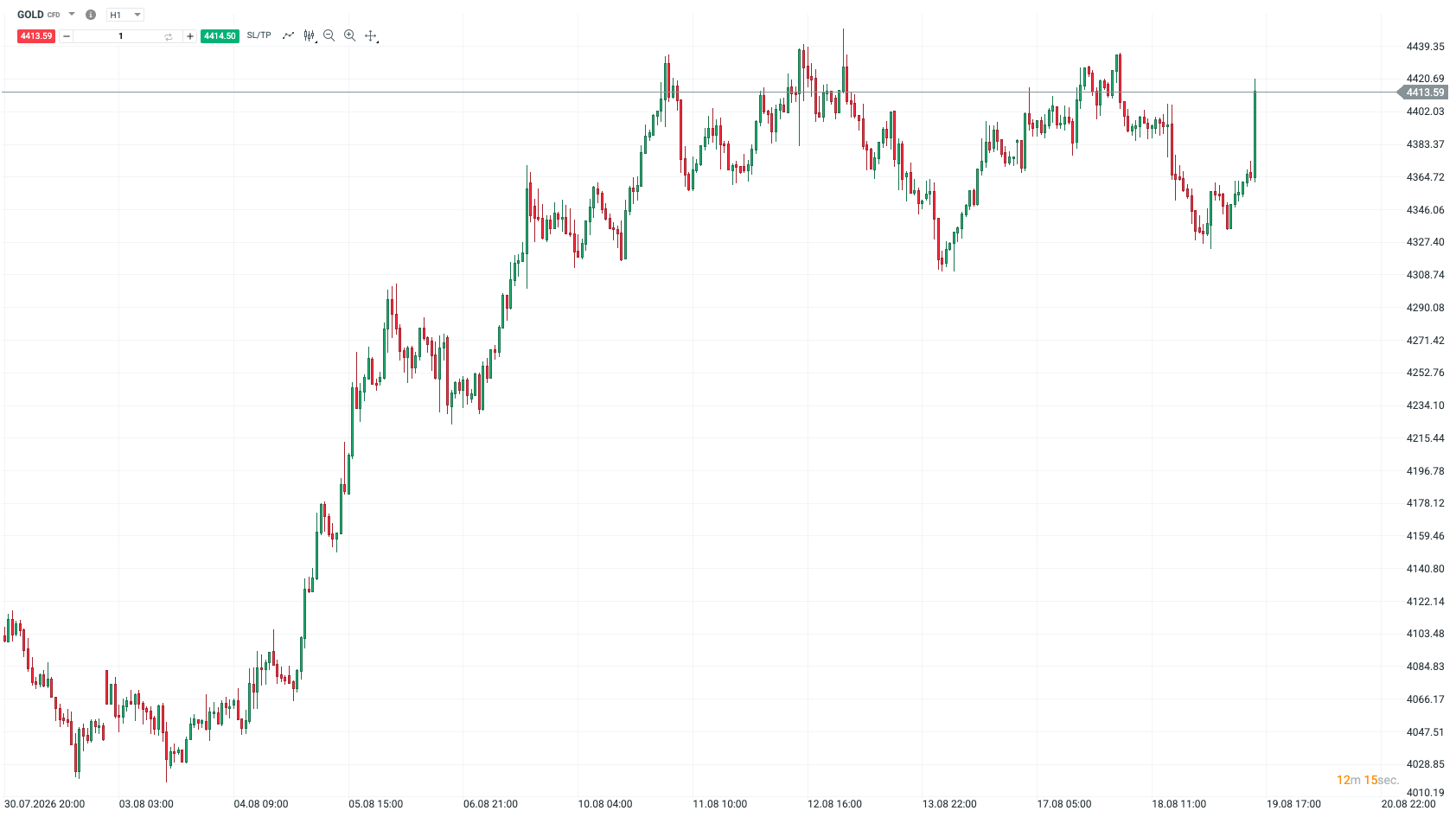
Source: xStation5
Central banks are adding gold reserves in large quantities
Another important long-term support for gold prices are central banks. According to the World Gold Council, they bought a net 289 tonnes of gold in the second quarter, up 62% year-on-year.
Poland was one of the most prominent buyers, while China also continued to buy. Although the first half of the year did not bring the record volumes of previous years, from a long-term perspective, central bank activity remains exceptionally high.
The reason is quite simple. Central banks are trying to diversify their foreign exchange reserves while reducing their dependence on traditional reserve assets, especially the US dollar. Added to this, the high debt of the largest economies and geopolitical uncertainty further strengthen the importance of physical gold.
Investment demand was less clear-cut. Gold ETFs saw an outflow of around 45 tonnes of gold in the second quarter. However, their overall flows remained slightly positive for the first half of the year.
New maxima are not automatic
The long-term outlook for gold therefore remains relatively positive. However, this does not mean that the price will continue to rise without a break. In the coming weeks, US yields, the development of the dollar exchange rate and expectations regarding the Fed's next steps will be particularly important.
If yields continue to fall and the US dollar remains weaker, gold could gain further room to rise. If the opposite happens, a correction could occur. Yields return to recent highs maxA significant strengthening of the dollar would pose a certain burden on gold.
However, in the longer term, several factors remain that could support the price. In addition to continued purchases by central banks, these include the state of public finances in major economies and geopolitical risks. If the situation in the Middle East were to escalate further, gold could receive further impetus to growth and possibly set new historical highs. maxhave.
But gold isn't the only commodity whose price is affected by geopolitics, supply, demand, or the state of the global economy. If you want to better understand what's behind the price movements of the most well-known commodities, you can free download XTB e-book "Top 7 Commodities".
CFDs are complex instruments and, due to the use of leverage, come with a high risk of rapid financial loss. 77% of retail investors have experienced a loss. You should consider whether you understand how CFDs work and whether you can afford the high risk of losing your funds. Investing is risky, invest responsibly.