Sponsored by: Berkshire Hathaway has been around for decades, evolving from a textile company into one of the world's most important investment firms. Of course, Warren Buffett, who led Berkshire as CEO for several decades, is a big part of that. Since the beginning of the year 2026 However, Greg Abel has taken over this position, and one of the biggest questions for investors is what Berkshire will look like under his leadership.
The first quarter with Abel at the helm did not bring any fundamental changes. The second quarter, however, was much more interesting. After more than three years, Berkshire Hathaway was again buying shares in a significantly larger volume than it was selling them. And it was not only the movement in the investment portfolio that was interesting. After almost a year of stagnation, Berkshire shares themselves also began to move more significantly, once again approaching historical levels. maxto the imams.
Berkshire's operating profit rose significantly
Berkshire Hathaway reported second-quarter revenue of $101,8 billion, up about 10% year-over-year. However, Berkshire's results need to be interpreted a little differently than a typical company's. A large portion of its business is driven by the development of its huge investment portfolio.
Changes in the value of investments brought Berkshire a profit of $12,7 billion in the second quarter, compared with $5 billion a year earlier. But this part of the results, according to Warren Buffett's long-term approach, is not very suitable for evaluating short-term performance. The value of shares simply fluctuates with market conditions, and price movements alone may not tell you anything about how Berkshire's individual businesses are doing.
More interesting is operating profit. This includes the results of companies that Berkshire directly owns, and in the second quarter it reached $12,98 billion. A year ago it was $11,16 billion. This is an increase of approximately 16% year-on-year.
And that's a pretty impressive number for a company the size of Berkshire. Berkshire doesn't just own a few companies, but an extensive portfolio.folio companies operating in insurance, energy, industry, transport and other areas.
After 14 quarters, Berkshire returns to buying
But even more interesting is the investment itself. Berkshire Hathaway bought $23,5 billion worth of stock during the second quarter. Share sales were only $3,7 billion. The result is a net purchase of almost $20 billion.
This is an important change for investors. Berkshire had been a net seller of shares for the previous 14 quarters, or more than three years. Instead of investing, the company was hoarding cash in large quantities and waiting for opportunities to arise that it deemed sufficiently attractive.
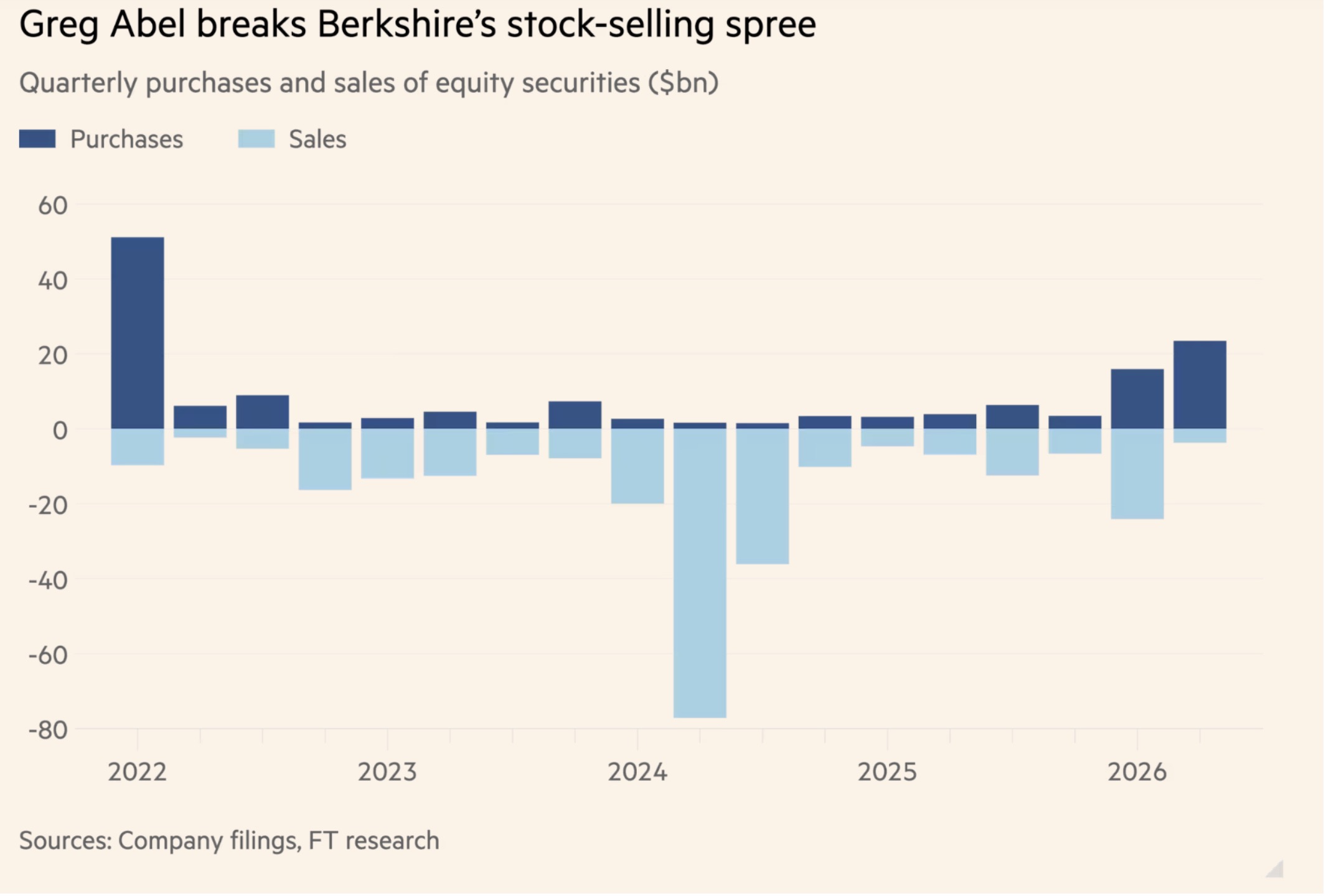
Source: Company filings, FT research
That's why the recent resurgence in buying is so significant. Berkshire isn't the type of company to buy stocks blindly just because the market is up. If it decides to invest tens of billions of dollars in a single quarter, investors are understandably wondering where management sees an interesting opportunity.
Alphabet becomes one of Berkshire's largest holdings
One of the most interesting changes is Alphabet, Google's parent company. According to the latest information, it has entered Berkshire Hathaway's top five stock positions for the first time ever. Alongside it, this group includes, for example, American Express, Apple, Bank of America or Coca-Cola.
Even more interesting is the scale of the investment. In June, Berkshire invested $10 billion in new Alphabet shares in a record offering to fund AI infrastructure. Berkshire acquired the shares at a discount of about 6% to their then-current market price.
This is a rather interesting move for Berkshire for another reason as well. The company has long been rather cautious about technology investments. The growing position in Alphabet may therefore be a signal that management sees long-term potential not only in Google itself, but also in the field of artificial intelligence and cloudof services.
Berkshire also significantly increased its buybacks
But it's not just about buying other companies' shares. Berkshire also significantly increased its share buybacks in the second quarter. While it spent only $235 million on them in the first quarter, it was already $4,5 billion in the second quarter.
This is not a random move for Berkshire either. The company has historically been relatively conservative in its approach to buybacks, purchasing its own shares primarily when it considers their price attractive. The jump from $235 million to $4,5 billion could be another signal that Berkshire's management sees an interesting opportunity in the company's current valuation.
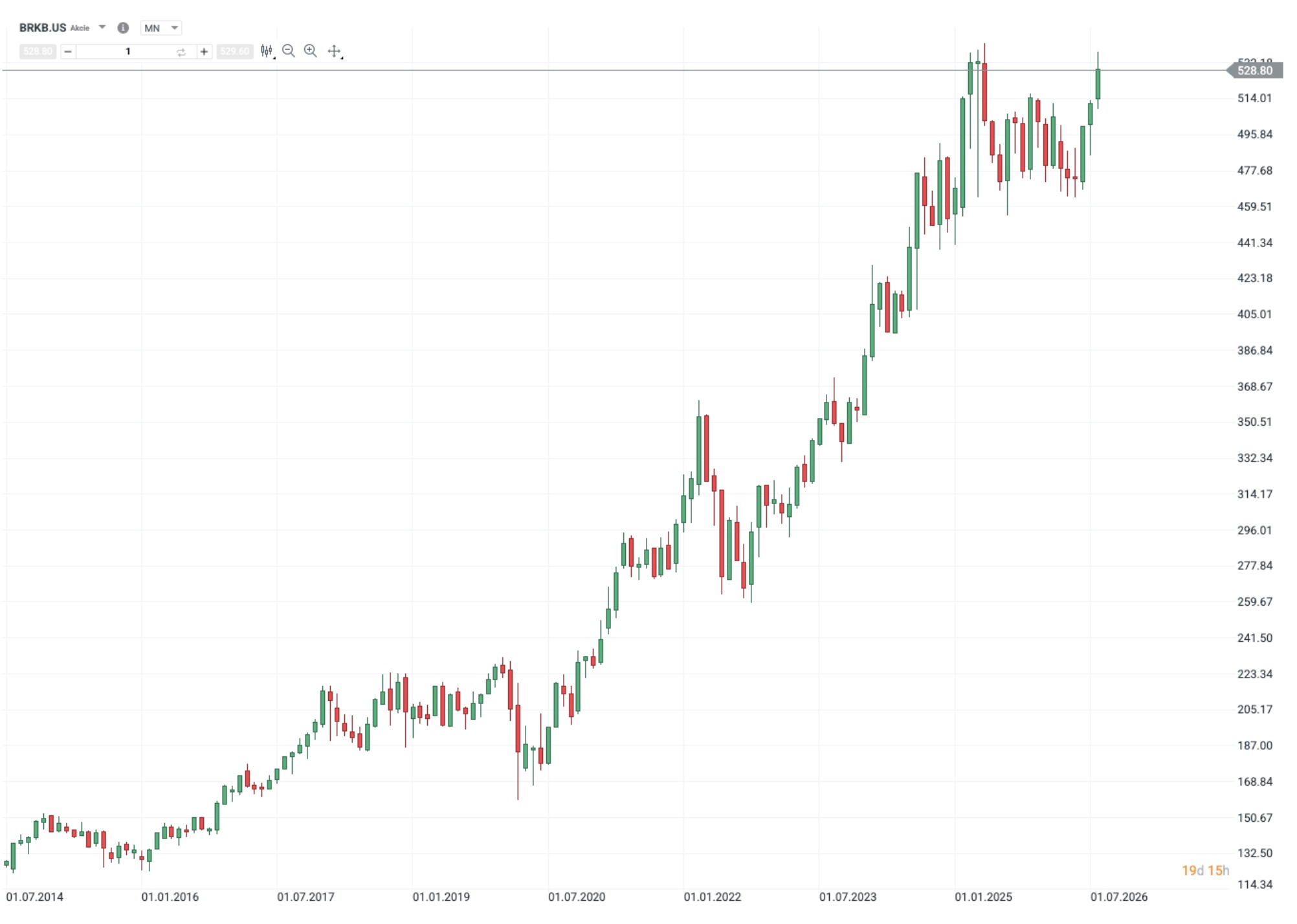
Source: XTB
The more active use of capital has, of course, also affected Berkshire's huge cash reserve. It has fallen from a record $397,4 billion to $365,5 billion. Nevertheless, the company's cash position remains exceptionally strong. It is also the first significant decline in cash in about four years.
But uncertainty in the markets has not disappeared
Despite the return to more significant investments, Berkshire does not expect further developments to be risk-free. The company continues to draw attention to uncertainty in the global economy, listing geopolitical conflicts, trade policy, tariffs, and potential problems in supply chains as the main risk factors.
Their impact, according to Berkshire, is impossible to predict with certainty. They could affect the availability of certain products, the costs of individual businesses, and consumers' willingness to spend. In the event of a significant deterioration in the situation, the problems could be reflected both in the operating results of companies owned by Berkshire and in the value of its investment portfolio.
In any case, the second quarter indicated that Berkshire Hathaway, under Greg Abel, is starting to use its huge capital more actively. After more than three years of net stock sales, purchases of almost $20 billion were made, share buybacks increased significantly, and Alphabet became one of the largest positions.
Investors will be interested to see whether this was just a case of taking advantage of a few specific opportunities or whether Berkshire is truly entering a new era. If the latter is the case, how Greg Abel will start working with the company's huge cash reserve could be one of the most interesting things to watch in the coming quarters.
XTB focused on the development of Berkshire Hathaway, its investment strategy and most important positions in your e-book.
Investing is risky. Invest responsibly.